
The Invisible Man

I was in downtown recently, and after dropping off and picking up books at the library, I found myself in Press Bay Alley staring at The Invisible Man. Matching, good-quality dress shoes. Obviously worn. I was on my bike otherwise I might have picked up a shoe and investigated the heel. No evidence of a body, although I could imagine a man in a black suit standing there, his arm raised in a welcoming gesture.
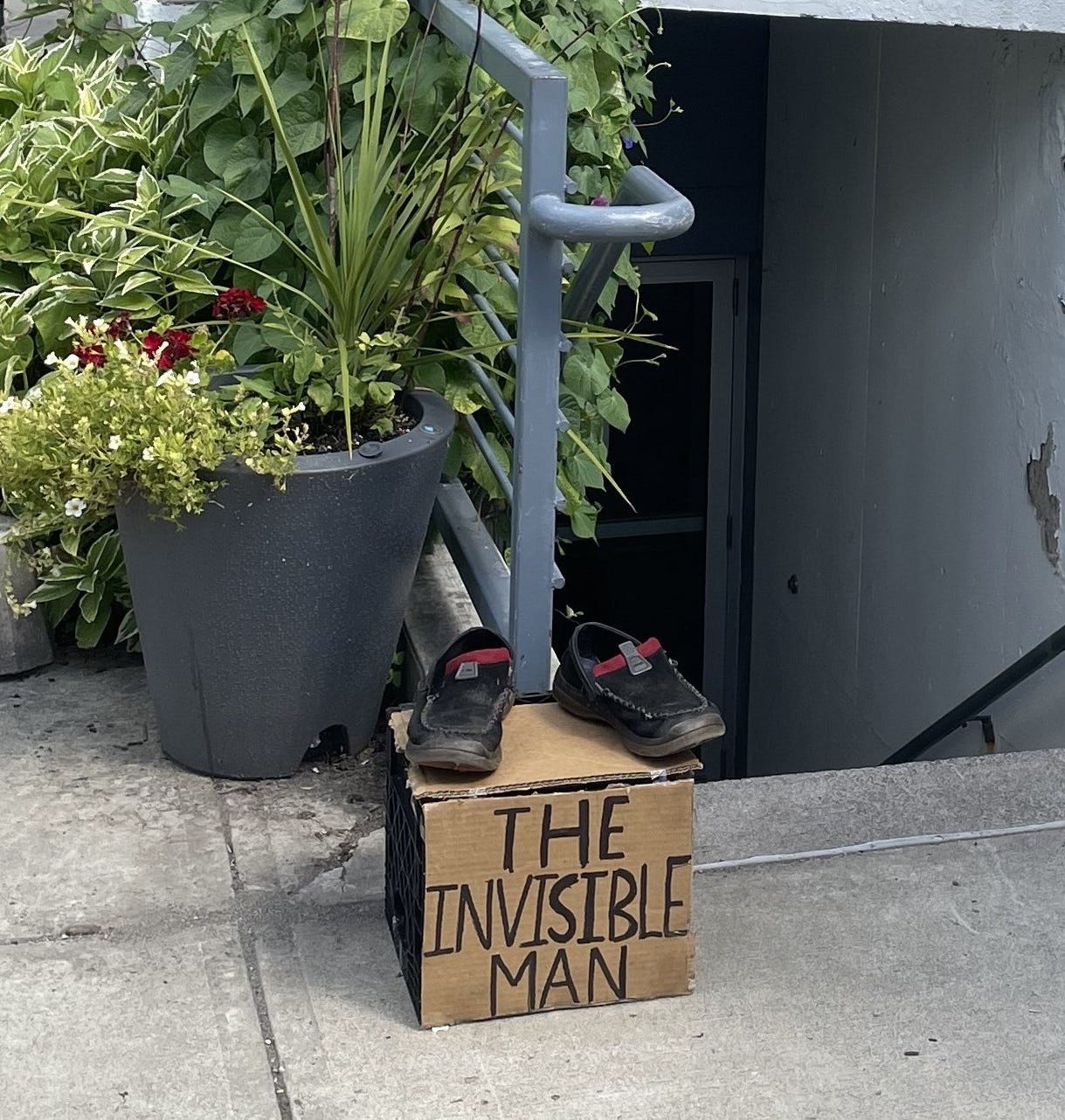
The Invisible Man at Press Bay Alley.
The original The Invisible Man book was written in 1897 by HG Wells. Almost 130 years old, the book stands the test of time. I started reading it last night and found it riveting from the very first paragraph.
“He was eerily prophetic,” Mike said.
I did not know HG Wells had written over 100 books. There have been comics and many movies about The Invisible Man, and I’m sure I saw part of the original 1933 movie with my mom. She loved watching movies in the afternoon, and I loved watching movies with her, especially if there was singing and dancing but this was not a singing and dancing movie.
Here’s the book’s summary from Wikipedia:
a scientist who has devoted himself to research into optic and invents a way to change a body’s refractive index to that of air so that it neither absorbs nor reflects light. He carries out this procedure on himself and renders himself invisible, but fails in his attempt to reverse it. A practitioner of random and irresponsible violence, Griffin has become an iconic character in horror fiction.
Interesting term: irresponsible violence. Isn’t all violence irresponsible? Maybe this is over-the-top violence?
There are times when I would not mind being invisible, like when I’m in the woods, walking and thinking, not wanting to break the spell and share thoughts with anyone who walks by. Or I’m listening to an intriguing podcast. Or I say something that’s not kind, truthful, helpful and timely; something, my therapist used to say that will “come back and bite me.” It’s easier to say such things online, and I’ve recently done that. That’s when I really want to be invisible.
So I went apple picking, without the intent of engaging in any irresponsible violence.
Apple Picking
I rode my bike to my preferred apple orchard, Indian Creek Farm, three miles north. With saddle bags and a milkcrate on back, I can carry over 20 pounds of apples. There’s nothing like a fresh apple just picked off the tree.
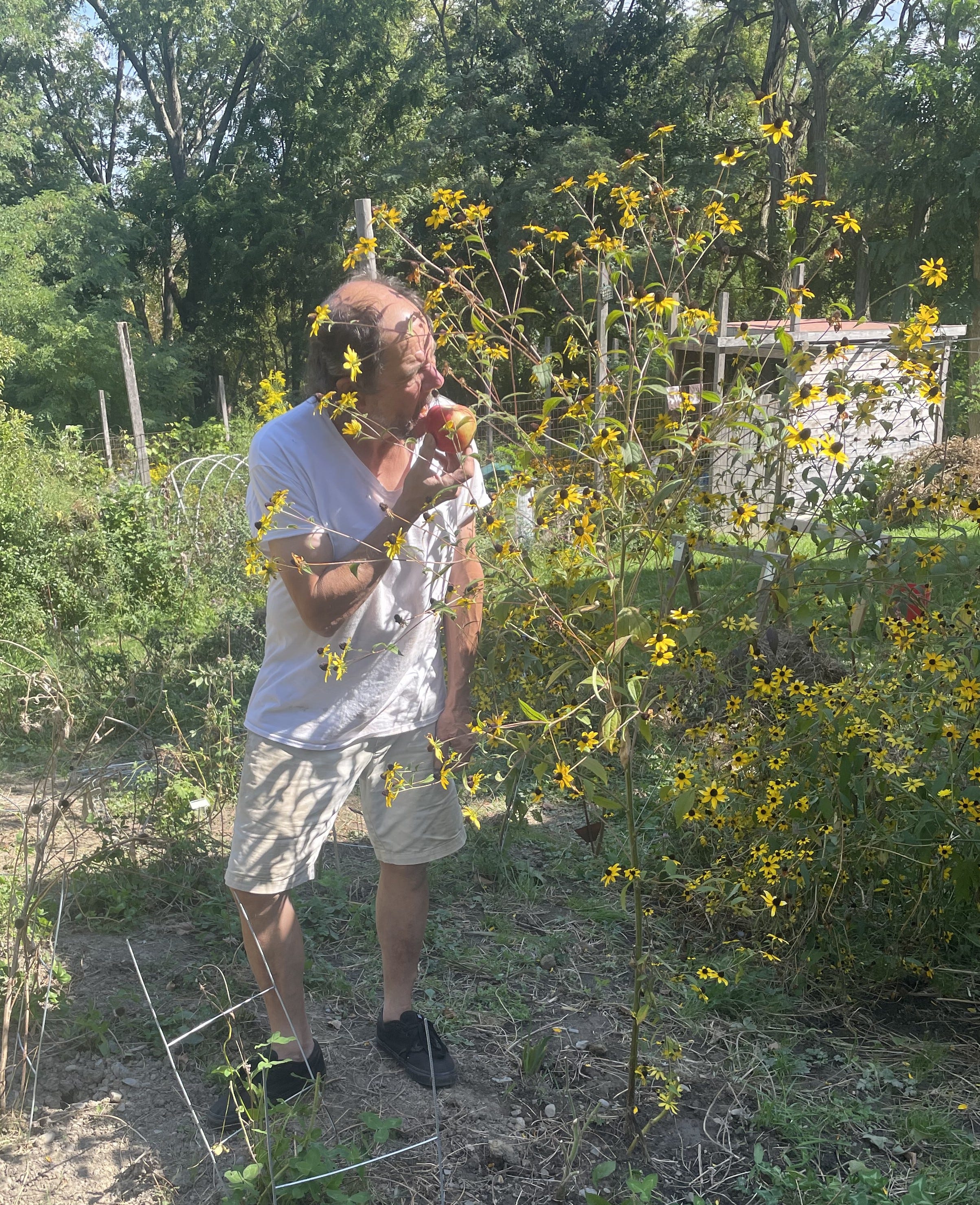
Mike holding a Honeycrisp beside many brown-eyed Susans, or rudbeckia triloba. Also known as thin-leaved coneflower. In the background, black locust trees.
My attempts at growing apples trees have failed, however, I have been successful growing wildflowers, such as rudbeckia triloba. There are at least a dozen five-foot-tall rudbeckia triloba that Mike and I can see from the dining room window, all grown from seed sown a year ago last spring. The rudbeckia blooms from July into early October. They seem to be right on schedule.
There are about 25 species of rudbeckia but only three are native to New York state. I have two of the three, the triloba, and the laciniata, or green-headed coneflower. Both attract the usual suspects — butterflies and bees — and provide nutritious seeds for not only goldfinches but chickadees, sparrows and juncos. I would say they are responsible native wildflowers.
It’s common now to see American goldfinches hanging on the spindly branches of triloba, picking out seeds. Rudbeckia’s branches are not so sturdy, and it surprised me that the branches could even support a goldfinch, but a goldfinch doesn’t weigh much, around half an ounce, which is also the weight of a single potato chip. Same with the chickadees. As soon as a finch or chickadee gets a seed, they fly into the tall arbs and cedars that border on the property’s west side. They hang in the trees so they can eat in privacy. They feel safe there. They really want to be invisible.
One morning, Mike and I counted 11 American goldfinches pulling out seeds from the rudbeckia centers. Goldfinches will hang out in Ithaca year-round if the winter is mild and they have food. Some birds are migrating now, those not keen on the cold and snow. I’m keeping my rudbeckia and monarda (bee balm) up until spring for the birds and the bees. The birds get the seeds and bees, a nest in the stalks. Another rudbeckia benefit is that the plant appears to be both deer- and groundhog-resistant.
This was an especially hot summer. You can see in the above photo with Mike that the soil is dry and parched. I wanted to sledgehammer in some rebar and tie up some plants that were falling down, but the soil was hard as rock. Our average rainfall in August is generally 3.77 inches; this August we got about 0.82 inches of rain. September average is around 2.5 inches, and we got less than a tenth of that, or 0.2 inches. I’ve had to water my wildflowers several times, in addition to the tomatoes and kale out back. And it’s not only lack of rainfall here that baked the land, but in early October, it was still 82 degrees. Sixteen degrees above average. That was disconcerting to me.
Native Plants
I spent several hours this summer inventorying the plants growing on our property, which is a little under an acre. Volunteers come from the woods, which, behind the house, is a half mile deep, and across the road from Ecovillage, clustered housing, sitting on 175 acres. I walk there often and have noticed many invasives, including the cute but dreaded brown knapweed, which has established itself all around the neighborhood. The knapweed was so thick and dense that I hired Evan to help me mulch over it.
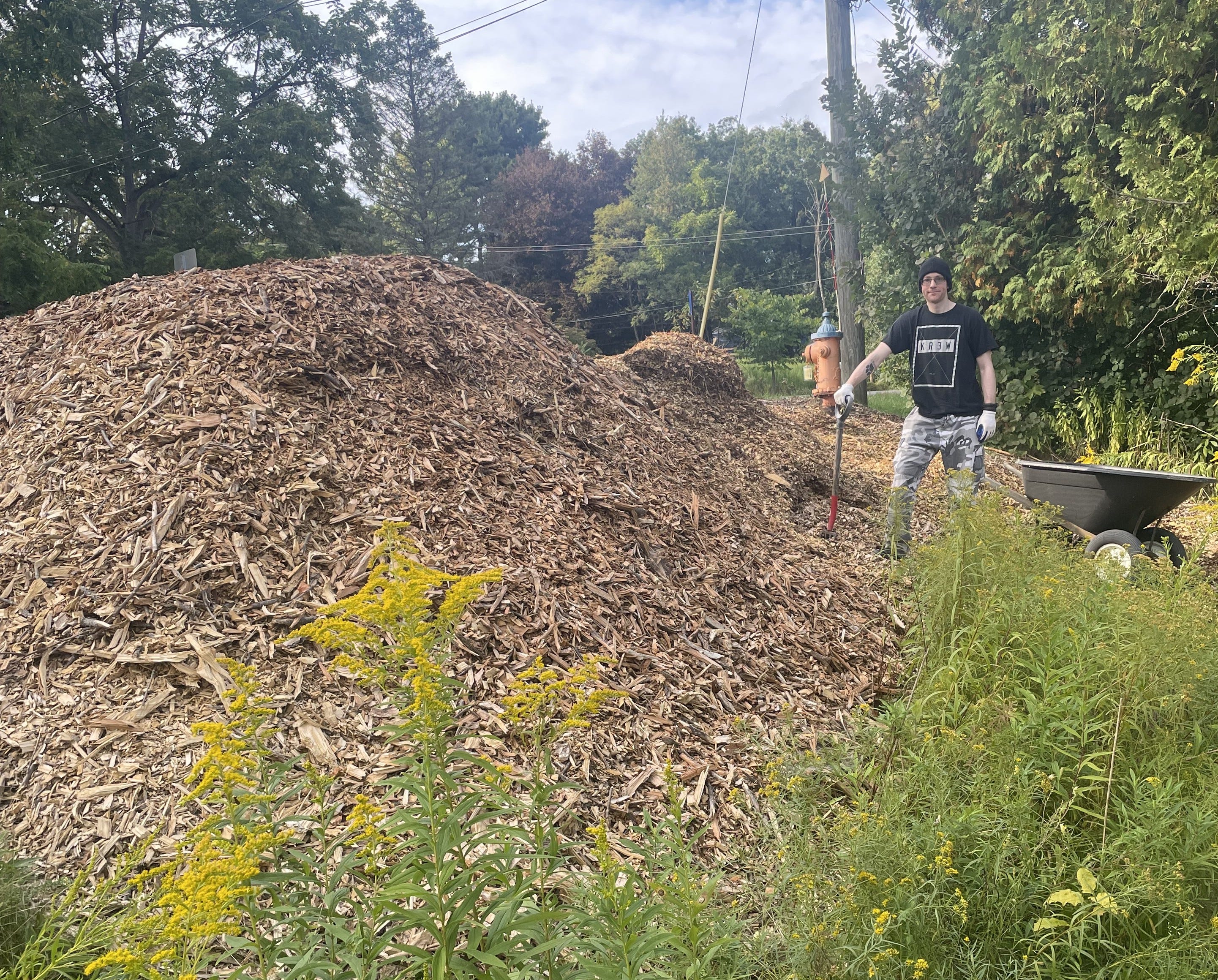
This summer several neighbors had trees trimmed, and I happily took all byproducts. It was all free! Thanks, Evan, for a great job!
Also free is the app Flora Incognita that I used to identify plants on my property. These are the plants I identified: catnip, bee balm (monarda), goldenrod (common, grass-leaved, wrinkleleaf and Canadian), Virginia creeper, calico aster, white panicle aster, stonecrop, motherwort, tall fleabane, black eyed Susan, garden lupine, fern-leaf yarrow, dense blazing star, self-heal, Joe-Pye weed, boneset, wild carrot, New England aster, Carolina horse nettle, purple leaf willowherb (host for butterflies and caterpillars), thin-leaved coneflower (brown-eyed Susan), black-eyed Susan, chicory, crane’s bill geranium, borage, calendula, Rose-of-Sharon, soapwort, oriental lady’s thumb, common nettle, stinging nettle, hawkweed oxtongue, wild snapdragon, hedge parsley, comfrey, wild spinach, pale swallowwort, horsetail, brown knapweed; wild spinach, clover, bird’s foot trefoil (the latter, highly invasive—that was a problem), and finally common fern. I’m sure I did not identify all of them.
Of the bunch, the goldenrods and asters are the best pollinators because they
provide sustenance, breeding sites, and overwintering spaces for numerous native species of bumble bees, long- and short-tongued bees, wasps, flies, butterflies, moths, beetles, spiders, and more. . . Goldenrod is one of the absolute best native perennials for biodiversity.
If you are tempted to weed-whack the goldenrod or pull up the asters, wait. Think twice. Your weeds could be supporting a very cool ecosystem.
Birds Again
Back to the birds. I wondered: how did the goldfinches, and so many, which have never been to this property before, know about my rudbeckia? Apparently goldfinches have very good eyesight. As they flew overhead, they spotted the bright yellow flowers from the sky.
Cameras
Speaking of seeing from above, Mike and I recently attended a meeting in Ithaca about Flock cameras. These are cameras that take a high-resolution photo of your car’s rear plate and can also ID the car’s make, model, and color. In Ithaca, the data is shared among more than 100 New York state municipalities. Supposedly the data is erased every 30 days, but who’s to say someone with nefarious and irresponsible intent does not download the data?
Data has been misused, and some cities, like Austin, TX, axed the program. According to one source:
There is [are] not enough companies out there that can guarantee that our data will be protected. . . . The data collected could be used to track down people seeking abortions and gender-affirming care. That’s the concern here: the dramatic negative impact on civil liberties and privacy for our community with programs like this.
Another source:
Flock does not protect Austin’s vulnerable communities from mass surveillance, and that is really concerning as immigration and deportation efforts have escalated. Austin should not be participating in Trump’s mass surveillance programs. We have evidence that ICE is actively collaborating with Flock, and essentially has side door access to Flock’s cameras and data.
Mike and I both came away from the meeting opposed to the cameras. Yes, we agreed, the cameras would help find lost people and maybe solve crimes, but we don’t have so many crimes here. We had one murder in Ithaca last year: a husband killed his wife, then turned himself in.
Would a Flock camera have helped?
A neighbor down the road said, “What’s the big deal? You obey the law, and you have no problems.”
“Maybe,” I said. “But the laws keep changing.”
Is Expressing an Opinion Against the Law Now?
For instance, the Trump Administration has demonized anyone expressing a negative view against the murdered influencer, Charlie Kirk. Some have been doxxed or lost jobs. This is what “Race, Racism and the Law” wrote about Charlie Kirk:
Behind the branding of “patriotism” and “freedom,” the record shows a pattern of rhetoric, organizational culture, and alliances that echoed white supremacist and Christian nationalist ideologies. . . The evidence remains overwhelming: Kirk and TPUSA did not need to wear hoods or wave Confederate flags to advance the logic of white supremacy. By denying systemic racism, vilifying movements for justice, and legitimizing extremists, Kirk and his organization reinforced the architecture of racial dominance in America. That was the through-line of his political project. He positioned himself as a defender of liberty, but the liberty he envisioned was conditional—anchored in whiteness, Christianity, and exclusion. His legacy is not simply conservatism. It is a record of advancing ideas and practices that aligned with white supremacy, even if he never wore the label himself.
More on Free Speech
Mamodou Taal was a Cornell graduate student and Palestinian rights activist. He protested – that’s all – just exercising his freedom of speech — and threatened with deportation, he self-deported in April 2025. Recently, in a related case, a District Judge, Judge Willliam Young ruled against deportation efforts of pro-Palestinian academics, calling it “a deliberate attack on free speech.” He also referred to Trump as
a bully who “ignores everything,” engages in “hollow bragging” and uses his power and gifts of communication to strip away constitutional rights. . .The President’s palpable misunderstanding that the government simply cannot seek retribution for speech he disdains poses a great threat to Americans’ freedom of speech.
I fear President Trump believes the American people are so divided that today they will not stand up, fight for, and defend our most precious constitutional values so long as they are lulled into thinking their own personal interests are not affected. Is he correct?
I wonder too.
Don’t be invisible
I’ll be visible on October 18th at the No Kings protest in Ithaca. I’ll be protesting the vindictive prosecutions of NYS Attorney General, Letitia James, and sitting Senator, Adam Schiff, and others. Deportation without due process. Bailing out Argentina. Unlawful firings. The deployment of the military against American citizens and immigrants in Chicago, Portland, and other cities.
Protesting, because as the founders of No Kings have declared: “In America there are no kings. The power belongs to the people.”
I recently published a short story along those same lines, and it’s on my website at https://patriciadutt.com/computer-pin/. I’d love to hear any comments on it.
Notes
Rudbeckia – Native Plant of the Week – Fruition
Ithaca August 2025 Historical Weather Data (New York, United States) - Weather Spark
10 plants that bring birds to the garden - Garden Center
Goldfinch Migration + When They Migrate in Your Area
Austin ends license plate reader program over privacy concerns | kvue.com
Austin’s license plate reader program will end this month | KUT Radio, Austin’s NPR Station
Charlie Kirk, White Supremacist, Dead at 31
Judge Rules Trump Unlawfully Targeted Noncitizens Over Pro-Palestinian Speech - The New York Times
Speaker clashes with Dem senators over Epstein files amid shutdown - Live Updates - POLITICO
Who’s next in Trump’s campaign to bring charges against his foes - The Washington Post
Thank you.
Enjoying your articles. Kathy (Keeler) Trager