
Invasion

After a few days of heat in April when my peach and plum trees threatened to blossom early, it seemed like summer was right around the corner. But summer wasn’t around the corner and temperatures dropped back into the twenties. If a deep freeze comes after the fruit trees blossom, the buds can die. When this happened in 2023 (May 18th, temperatures dropped into the 20s), I had no peaches or plums. The You Picks nearby? They lost 90 to 100 percent of their fruit crop.
In May I examined my fruit trees and was happy to see small green fruits hanging near the branch ends. The cold weather had not killed the blossoms.
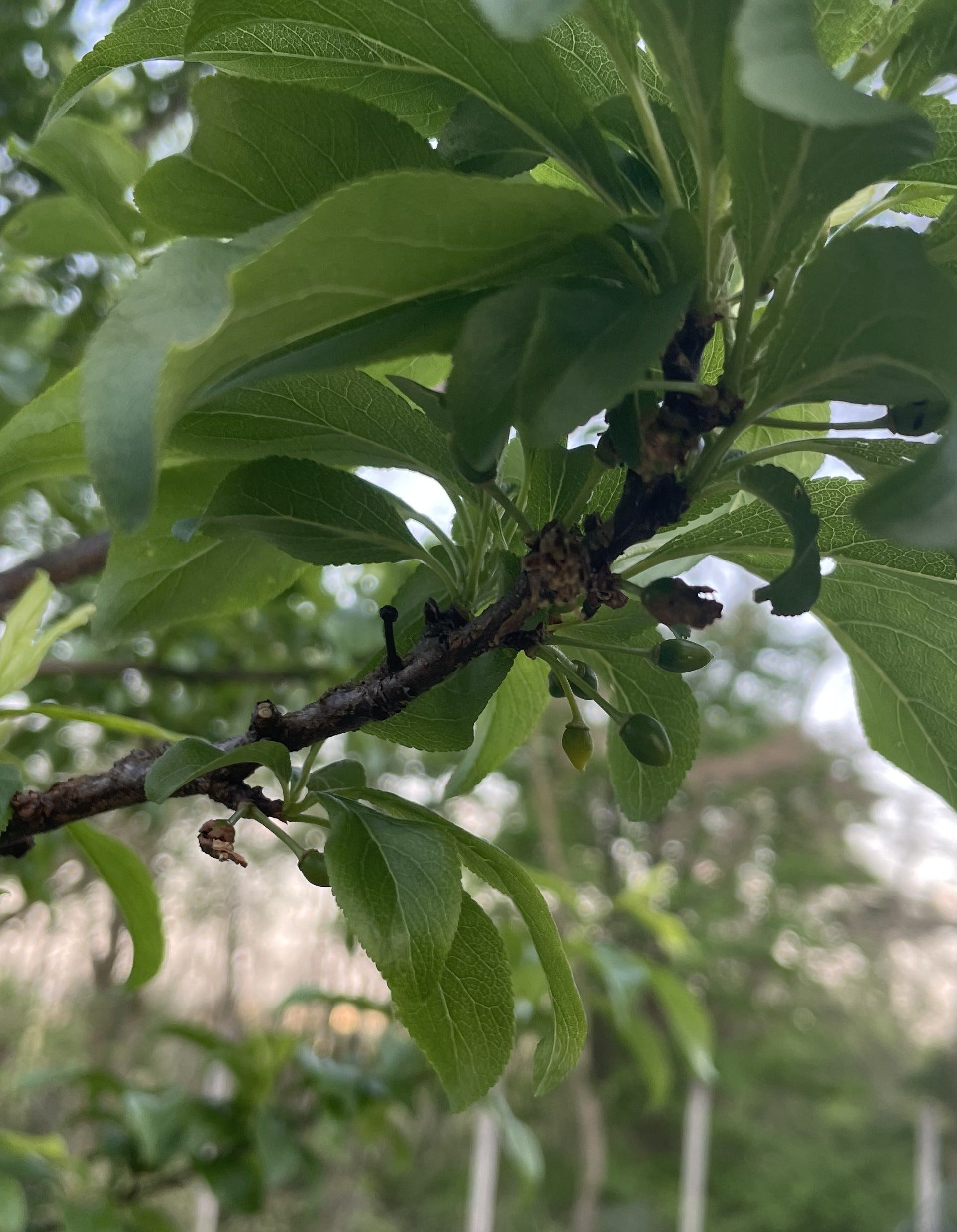
Several small green fruits, proof that plums are still a possibility this year.
The early warm weather also woke up the stink bugs. They had been hiding out upstairs in drawers, closets and the backs of curtains. They entered in fall at night when we were listening to ELO and reading. We did not know how many. A frequent-flyer Airbnb guest mentioned finding 40. Forty! Forty for one night is a lot. That could doom an Airbnb. Right away, Mike caulked around the windows, suspected entryway.
Then we waited.
Stinkbug Facts
When you know your enemy, victory is more likely, so I researched Halyomorpha halys. They hitchhiked a ride across the ocean, likely in a shipping container from China. Other pests have done this too, like the Emerald Ash Borer. The stink bugs arrived at Allentown, Pennsylvania in 1998. When I bought my house, also in 1998, I did not know what a stinkbug was; their presence was discovered around 2010 in Ithaca.
At present the brown marmorated stink bugs (BMSB) have been documented in all states except Alaska, South Dakota and Wyoming. Why so many stinkbugs? According to Wikipedia:
“Stink bug populations rise because the climate in the United States is ideal for their reproduction. In optimal conditions, an adult stink bug can develop within 35 to 45 days after hatching. Female stink bugs can lay 400 eggs in their lifetimes. The bug can also produce at least one successful generation per year in all areas of the United States . . . In warmer climates, multiple generations can occur annually. . . ranging from two to six generations.”
Two to six! I felt lucky that we have cold weather seven months a year. Because I was trying to outsmart them, I began looking for them everywhere. I found my first baby stinkbug on May 18th, while bringing in the laundry.
“Make sure he doesn’t grow to an adult,” Mike said.
Stink bugs don’t carry bacteria or poisons that could harm humans, but they are a nuisance to people, and especially to people like Mike. For some reason, they like to dive bomb into his forehead.
Stinkbugs eat a wide variety of fruits and vegetables – not just one or two like some insects – ensuring them greater success in the insect world. Their high survival rate is certainly not good for fruit and vegetable farmers. Wikipedia again:
“Stink bugs use their stylets to pierce the plant tissue to extract the plant fluids. In doing so, the plant loses necessary fluids, which can lead to deformation of seeds, destruction of seeds, destruction of fruiting structures, delayed plant maturation, and increased vulnerability to harmful pathogens. While harvesting the plant’s juices, the stink bug injects saliva into the plant, creating a dimpling of the fruit’s surface and rotting of the material underneath.
Other facts about the notorious brown bug:
· lifespan is six to 10 months, generally longer in warm humid climates
· they can survive two to three months without food
· they can survive 10 to 15 days without water
· their defensive spray is not a pheromone, but an aldehyde, such as trans-2-decenal and trans-2-octenal; in enclosed spaces with a lot of stinkbugs, the smell can persist up to a day
· they do not reproduce inside the home, although Mike mentioned that he had definitely seen the male (Hey baby, hey baby!) and female in close proximity
· this site, Stink Bug Life Cycle-Eggs, Baby Stink Bugs, Adults & Span | Pestbugs, has photos of the eggs, which are laid on the underside of a leaf (outside the house), and baby stink bugs, like the one I found
We thought the ladybugs hanging around the ceiling might be baby stinkbugs; they are similar but not the same!
Stink bugs are content to be outside from fall to late summer, but as fall approaches they want warmth. When stinkbugs enter your house in October, they “will produce pheromones (lasting minutes to hours) to attract other stink bugs and communicate it has found shelter. This is why when you find one stink bug, there are usually more hidden nearby.”
US EPA and Cornell Research
Remember the US EPA? That federal agency whose mission is to “protect human health and the environment?” It has not yet been totally dismantled. They reported: “In areas where they are established, they can enter structures by the hundreds or thousands.”
That puts my 40 in perspective.
One Cornell research site indicated as many as 20,000 stink bugs could enter a structure.
“Once inside,” (EPA again), “they may congregate almost anywhere, including bookcases; under beds and sofas; in cracks under or behind baseboards, window and door trim; and in attics. These pests will not cause structural damage or reproduce in homes. They do not bite people or pets and they are not known to transmit disease or cause physical harm. However, some people may be sensitive to allergens given off by the stink bugs.”
I haven’t heard of anyone being allergic to stinkbugs, but you never know.
In 2011, EPA approved use for “an insecticide that contains azadirachtin and pyrethrins derived from botanical ingredients.” I don’t know if anyone has used this insecticide, although when I went online I noticed several products that did not exist even few years ago: Stink Bug Trap, Ultrasonic Stink Bug Repellent, Stink Bug Dead-Inn Trap, Stink bug Killer Liquid Spray. We use the good old catch-and-bottle: caught with the fingertips (no squeezing), we deposit the bug into a glass bottle with kombucha dregs at the bottom.
Stink bugs en masse have become big problems for some industries. The EPA again:
“For example, cars and other vehicles manufactured in areas of the United States where brown marmorated stink bugs are present must be fumigated or heated to temperatures over 122ºF for several hours before they are allowed into some international ports. The cost of these measures, which are intended to prevent introductions of brown marmorated stink bugs to new countries, can be significant.”
So it’s not only the tariffs making cars more expensive, but the stinkbugs which I had not imagined could be such a problem. Numbers, right? A few okay, but hundreds or thousands? That’s a problem.
Mike found plenty of stink bugs in the garage. “Mr. and Mrs. Stinkoo thought that hiding inside the high voltage (about 2200v) cage in a CRT (oscilloscope) was a good idea. So when I powered it up, a long sustained sparking and buzzing occurred. The smell wasn’t the usual “someone let the smoke out” burnt component but . . worse. One stink bug got his ass burnt. Lost a few legs too.”
What We Did
Mike not only sealed the windows upstairs, but he made sure the screens fit flush against the window frames. We generally keep our windows open. We have limited AC, and with open windows we can hear peepers at night and songbirds in the morning.
We hunted the bugs down: shaking out blankets, peering into dresser drawers. The majority emerged from two bedrooms upstairs, one with a north facing window (access to the downstairs “heating vent” and other between-the-wall places), the other bedroom with an east facing window. Both rooms had window AC units in them from late May to October. Clearly sealing the units in the window frames was not perfect.
This was their main entry way, but not their only entryway.
I read, “The long grass will make stink bugs feel safer making the journey across your yard.” I am a minimalist mower, so this statement gave me some pause.
“Even light peeking through blinds at night can draw the bugs closer to your home and exterior windows, where they may find a way inside through cracks and crevices. The bugs are attracted to multiple kinds of light, including white, yellow, blue, and UV black light.”
Okay, no lights on at night, especially when it gets cold. But how can they survive indoors for months? The clever devils
“. . . enter a dormant state called diapause, relying on fat reserves accumulated during the growing season. In this state, they may sip small amounts of water from condensation but generally avoid solid foods.”
As if they’re on a specialized diet. I read they do not eat inside. When we see them, they’re almost always hanging out around the windows, perhaps sipping window condensation, or waiting for a window to mysteriously open.
Stink Bug Deterrents
Everything I read about reducing (not eliminating) the indoor population suggested the proactive approach: sealing, blocking, reducing yard clutter (difficult for a wildflower person like me), turning off outdoor lights, using good indoor blinds. Even the light from inside the house attracts them.
Because of the stink bug’s “sensitive olfactory system” spraying solutions of select smelly foods/herbs and citrus scents may compel them to seek shelter elsewhere. You can spray those potential entry ways with a vinegar-and-water solution. One site suggested
“four teaspoons of garlic powder in two cups of water. . . . Other scents that stink bugs detest include clove oil, lemongrass oil, wintergreen oil, geranium oil, pennyroyal oil, rosemary oil and spearmint. . . Neem oil is another effective, natural remedy, derived from the neem tree.”
The stinkbug issue -- Where did all these stinkbugs come from and how do I get rid of them? -- appeared on the Next Door Listerv in March. Advice: “Make a spray with neem and spearmint. Or “Sprinkle diatomaceous earth and/or borax.” Also call pest control for October treatment to help next year with stinkbugs.” Two local services were named.
“Stink bugs can be quite troublesome,” I read on another site, “not only do they damage gardens, but they can also disrupt the serenity of your home.”
Another Spring Project
Stink bugs and the weather — with hotter summers now a certainty — were on our minds when Mike and I went to Home Depot. We decided we needed to install high quality insulative blinds. Last summer we taped insulation panels (Mike, ReUse store, three dollars) to the dining room/kitchen/bedroom windows. The house felt cooler by several degrees. But it was inconvenient and the heat blocking, we realized, could have been more effective. Blinds were going to be more than three dollars, and we wanted to do it right and talk to someone knowledgeable.
At Home Depot we were in deep discussion about blinds when Mike made a joke about stinkbugs.
“Oh, Halymorpha halys,” the HD associate responded.
Mike and I were impressed.
Our boots-on-the-ground HD associate/university researcher continued.
“They wax and wane, so there’s years when the population is low, and then it’s overwhelming.” He was part of a study that tracked stink bug population in agricultural areas where BMSBs (brown marmorated stink bugs) have done a lot of damage. Cornell had been trying to develop safe pesticides for both humans and plants. We never found out if the associate was a professor or grad student (he was in his 50s or 60s), but clearly, he was working below his education. We did not ask what happened to the project.
Are They Gone Yet?
By May, I found one or two bugs a day upstairs. In spring, the weather jumps all over the place, and I’m not always sure if they’re coming or going. The just when I went days without spotting a BMSB, an adventuresome Airbnb guest arrived from Texas. I warned her about stink bugs.
“I’ve never seen them,” she said, with a laugh. “They sound kind of interesting.”
I relaxed and laughed along with her. As long as there aren’t 40, and not all at once.
Notes
Brown marmorated stink bug - Wikipedia
What Attracts Stink Bugs and How to Keep Them Away
Stink Bug Life Cycle-Eggs, Baby Stink Bugs, Adults & Span | Pestbugs
How to Get Rid of Stink Bugs for Good
Trissolcus japonicus - Wikipedia
5 Things You Might Be Doing to Attract Stink Bugs
Stink Bug Lifespan and Life Cycle: How Long Do They Live?
What Are Stink Bugs Really Called
Brown Marmorated Stink Bug | US EPA
Biological Control of the Brown Marmorated Stink Bug in New York State. » The Jentsch Lab
Stink Bug Life Cycle-Eggs, Baby Stink Bugs, Adults & Span | Pestbugs
I remember seeing an occasional stink bug when I was in Pennsylvania, but never a whole bunch. There was one year when I was annoyed with them in Japan. I haven't seen any in California.
You are lucky, girl! Mike has boxes and boxes of audio equipment in the garage, and so far, all boxes have stink bugs in them -- dead ones -- it gets cold here. And from what I've seen, 30 to 50?