
Hard Times

What are those pieces of wood sitting on the woodstove hearth? If you guessed, piano keys, then you win the lottery. Or better yet-- how about a low, healthcare premium? Mike spent a week last winter taking apart our piano. A 100-year-old piano, it could no longer be tuned. We explored many options including the most practical: haul-it-away followed by slow landfill degradation, that option rejected because of expense ($450) and the mess we’d leave for future generations.
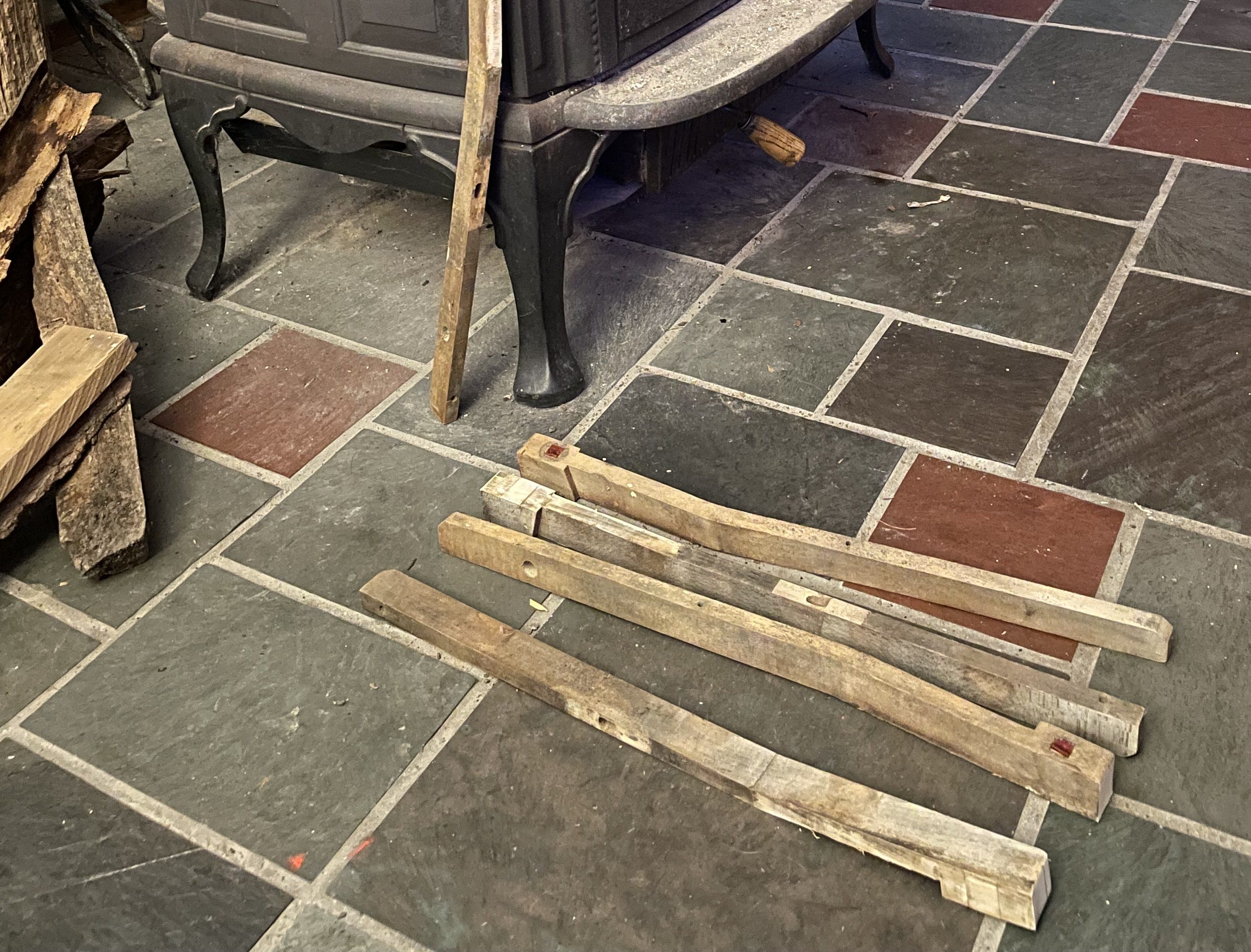
Wood keys from our old piano.
The wood keys are good kindling and a reminder that nothing lasts forever. We burnt the frame last winter. A local artist took other bits and pieces. Mike still has some wire, no doubt saving it for a project TBD. The metal part of the soundboard – the harp -- went to scrap metal while the soundboard riser became a hat and coat rack.
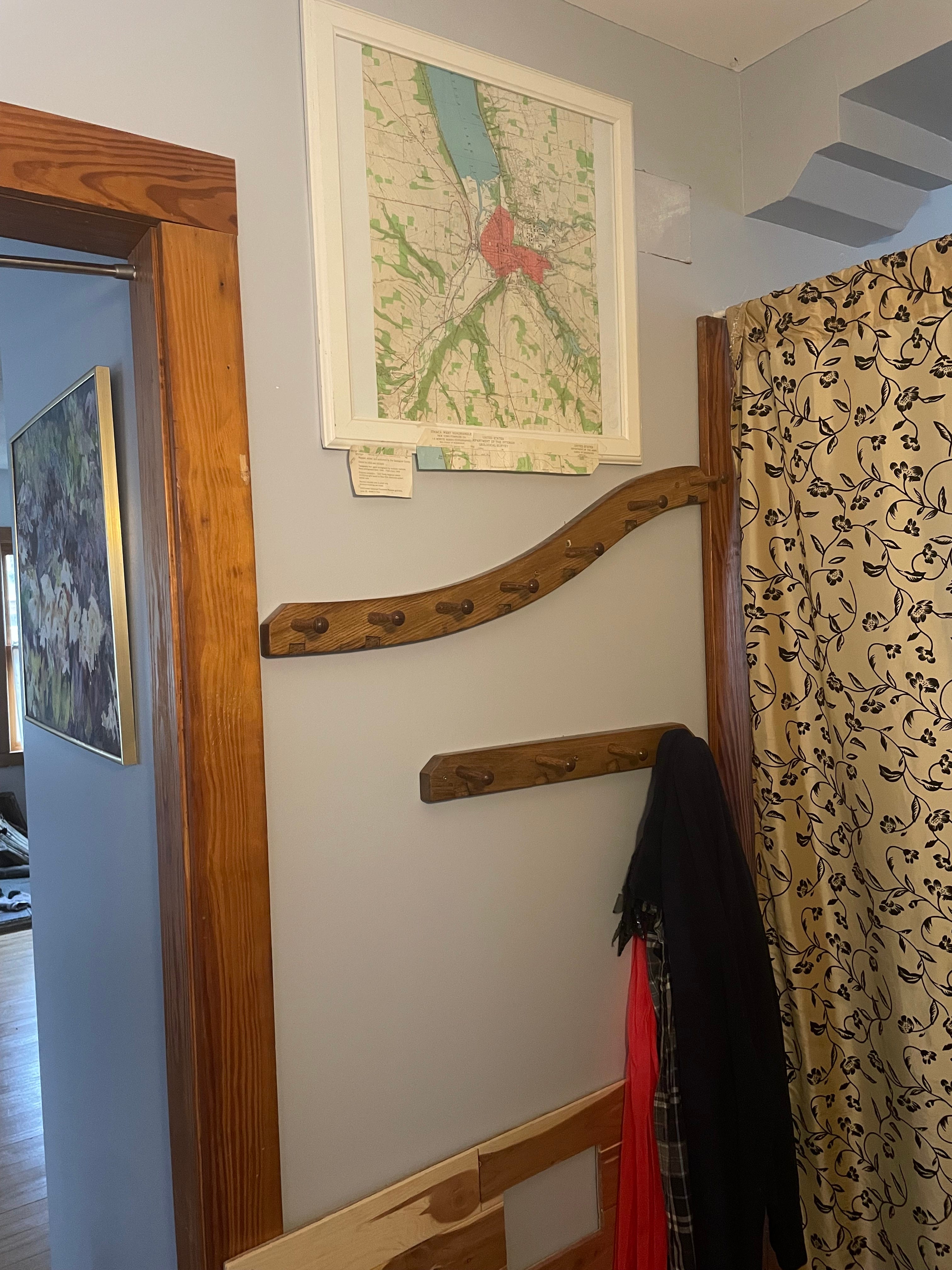
Soundboard riser that Mike sanded, stained, and polyurethaned. The curved wood was a good fit for the space. Above: a USGS map of Ithaca
When Mike repurposes, it gives him a jolt of satisfaction. It’s a good skill to have especially when costs of everything – except for old pianos – has gone up. It’s true: you can’t even give away old pianos.
University Economics
Our local economy relies heavily on Cornell. In March, Cornell instituted a hiring freeze after the Trump Administration withheld one billion dollars in funding, earmarked for research. Apparently, Cornell failed to protect Jews from students protesting the war in Gaza. (Despite the cease fire, Palestinians are still being killed.) I did find one or two articles in the Cornell Sun about two Jewish students who filed a discrimination lawsuit for violating the Civil Rights Act of 1964. Nothing notable concerning Gaza protests.
Living in a college town means we live in a bubble, and it’s a nice bubble where housing prices rarely go down, but the bubble lasts only as long as the university keeps people employed. Cornell University is huge and has a huge endowment, but you take away a billion dollars and that not only hurts the university, but the city, and the surrounding towns and villages.
Cornell employs 11,285 people in Tompkin’s County. It is our biggest employer ahead of Ithaca College, Wegmans, Cayuga Medical and the county. Those four organizations employ about 9,000 people.
A few weeks ago, I was biking into town and stopped to say hello to a neighbor who was building a retaining wall. “Cornell laid off one thousand last week,” he told me. That’s almost one out of every 10 employees. If I were looking for a job in Tompkins County, that statistic would worry me.
“Next week, Cornell’s asking others to take early retirement. They want 25 percent of the work force gone,” he added.
There’s a trickle-down effect. Even Mike and I, who are new old-timers, and own a house, have felt the effects.
Signs of Despair
For the past three years, I have parked my bike in downtown outside a volunteer food organization. Using a solid kryptonite lock, I lock my bike to a metal fence. This is in a publicly visible, high-traffic area. Some of those who dine there know my bike. At least one person, Jeff, had warned me previously not to leave anything in my saddlebags.
Last week I did what I usually do: I put my helmet, scarf, knit hat, and blue mittens in the milkcrate that Mike screwed onto the back of my bike. I finished my volunteer shift at 11:30, and it was bright and sunny out. People were walking on the sidewalk mere inches from my bike. When I saw plastic bags poking out of my saddlebags, I knew someone had messed with my bike. My back lights were gone, as well as hat, scarf and blue mittens. Not my helmet: if you’re freezing, a helmet isn’t going to do you much good. Luckily for me it wasn’t terribly cold out. Luckily I took my coat inside.
A friend mentioned the “spill-over effect”: the unintended effect of an action or event that goes beyond its intended scope. I have extra hats and scarfs, but I miss my blue mittens. They were perfect biking mittens: wool and warm. Not too thick or clunky. Mittens -- not gloves -- because mittens keep the fingers warmer. Anna saw where my mittens were unraveling, and she stitched them up for me, good and tight. The blue mittens have her handiwork in them. It’s as if I lost a part of my daughter.
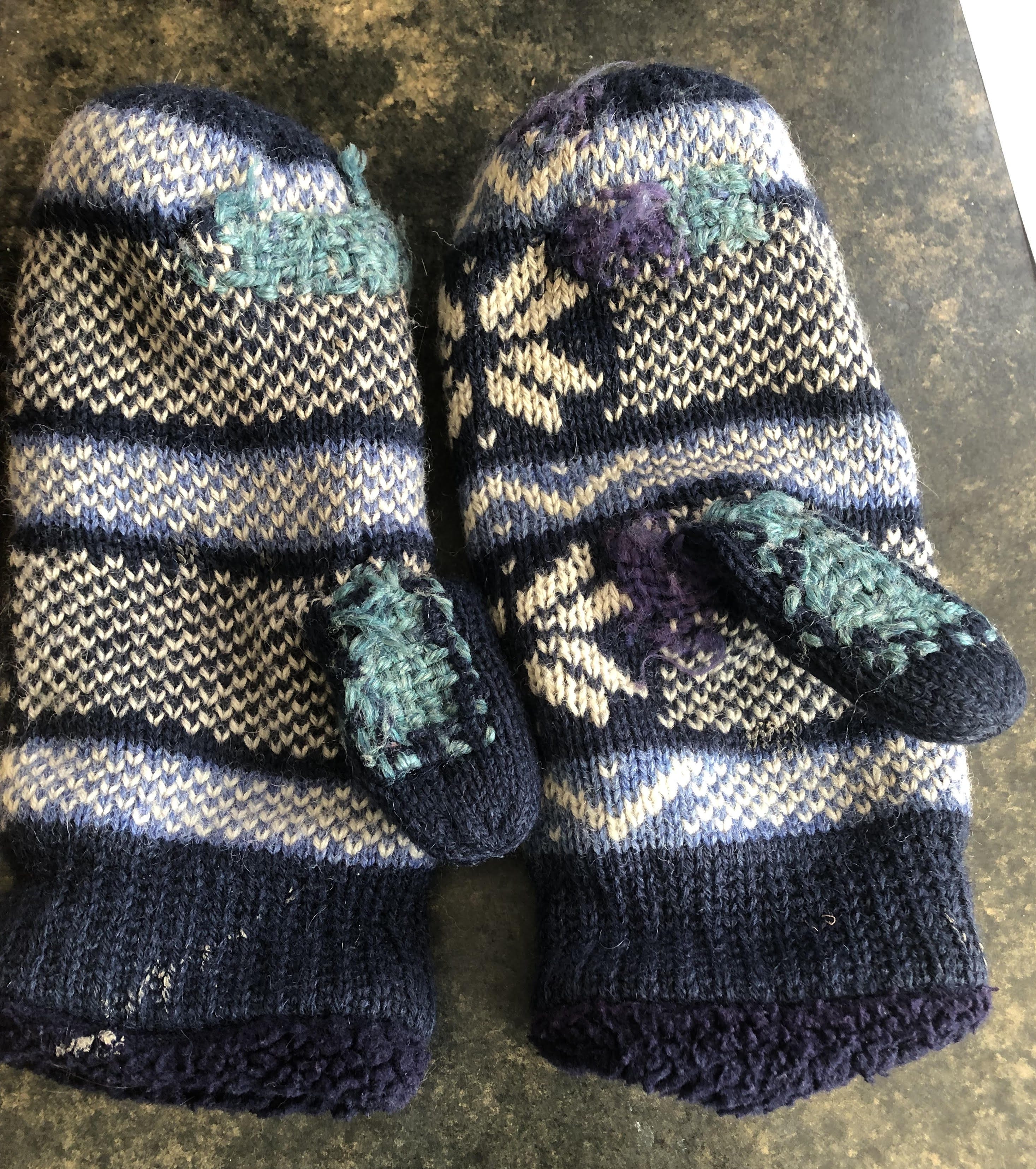
My blue mittens. From an earlier photo. At least I have a photo.
I love my blue mittens, and whenever I am out, I look at people’s hands, hoping to see them. If I do see them on someone’s hands, I will demand them back.
But I have not seen them.
Housing and Health Care
I have lived in Ithaca for 27 years, and this year is the first that I remember houses losing value. And we generally have a very low apartment vacancy rate – in the city less than one percent – but landlords have been posting that they have too many vacancies. Most of the non-subsidized apartments in the city are rented to Cornell students. At least one landlord mentioned returning deposits because his students could not get visas. Not only that, but I imagine the students’ dreams disappearing.
Mike and I have had difficulty trying to rent our basement apartment, although our target is not students.
Recently we interviewed a potential tenant: a traveling imaging technologist. She hung around and was giving us the inside scoop on health care expenses. One big problem, she said, was the huge salaries CEOs make. “They push paper around from one stack to another. They make no significant changes but pull in $300,000.” Then she mentioned patients who sue when an outcome is not to their liking. “A pregnant woman came in and we told her there was a danger of her getting a blood clot. Because she was obese. Forty percent of Americans are obese. The pregnant woman signed a paper that cleared the hospital of that responsibility. She got a blood clot and she sued the hospital anyway. It was easier to give her $10,000 than have the case drag out years in court.” She added: “People come into a hospital sick, and they die, and their relatives sue. People: they don’t live forever.”
I recently got a letter from my insurer, “Beginning 01/01/2026, Medicare Blue Essential (PPO) won’t cover your health care.” Nice. The letter went on to tell me about my rights, etc. and advised me to sign up for a seminar. So did weekly text messages sent by the same insurer. At the appointed day and time, I was at attention at my computer, ready to evaluate the pluses and minuses of the various healthcare plans when I couldn’t find a link. I immediately called the insurer who passed me onto someone else who tried to find the missing link. I missed the seminar, but I still had the first woman on the phone, and here I was, not only talking to a real person, but a knowledgeable person. She found a plan similar to my soon-to-be-extant plan. She asked about my medications.
“None,” I said.
“You must be the only person in New York state not on any medications!”
I smiled. Genes, good habits, an inability to sit still, kids on their own, and a partner who not only enjoys the challenge of taking apart pianos but loves ELO. He’ll even dance with me without too much elbowing.
My last plan was $185, but the representative on the phone could not tell me the cost of my new plan. “We just don’t know yet.” (Mike said, “Somewhere over $200.”) I got a letter two weeks later stating that my new Medicare plan is $299.60. Sold!
I was also sent a 131-page “Medicare & You, 2026: The Official U.S. Government Medicare Handbook” where all kinds of pertinent questions are answered, like, What’s an appeal? How do I file an appeal? It’s as if these businesses acknowledge they are cheating you, and you — the consumer — will not get away with anything. Except if you decide to sue.
Before I retired three years ago, I was paying around $230/month for health insurance. My employer – a small businessman who owned a landscaping business -- paid the other two-thirds. There were many landscapers, most who made less than $25/hour, who did not purchase health insurance because it was too expensive, despite the fact that their jobs were very physical, and sometimes quite dangerous.
I found a recent article from the Washington Post that compared present and future premiums – assuming that the future tax credits expire. The cheapest premium was $79 with its new premium almost doubling to $151. This guy admitted he was lucky. The highest monthly went from $1,269 to $2,746. Per month.
In addition, the article mentioned that
. . . out-of-pocket ACA (Affordable Care Act) credits will increase if enhanced tax credits expire by an average of 114%,” but the variation by income is tremendous. For those with a $18,000 income (poverty level for one person is $15,650) the premium costs soars from 0 to $378 dollars per month; for those at the $45,000 income level, the increase amounts to $1836 per month.
As if that were not shocking enough, “ACA enrollees with incomes above 400% of the poverty level…would lose subsidy eligibility entirely if enhanced credits expire.” For example, “A 60-year-old in Baltimore making $63,000 has an increase of $5,207. In Charleston, WV, it’s $22,509.” (Yearly premiums).
I haven’t heard anyone say that our health care system works well, especially given how expensive it is, and it seems even more so that middle class is being squeezed for every nickel we have. (The last penny was minted November 12, 2025). In Germany, people pay 7.3 percent of their salary for health insurance. Their employer pays another 7. 3 percent. I don’t know if Germany has outrageous lawsuits, or if CEOs make $300,000. I would guess probably not. Two years ago, when I was visiting family in Germany, I had an infection. My son-in-law took me to the doctor’s office at eight in the morning – without an appointment. There were ten people waiting. I was out by nine am -- not 9 pm -- with a prescription for an antibiotic. It cost me $30. Total.
There are other health care options, yes, and they are cheap, but their benefits are cheap. Many are promoted by Trump officials “as an alternative to plans sold under Obamacare.” Beware. The Post interviewed three people who required surgery -- neck, heart, knee replacement – and were stuck with bills of, respectively, $116,000, $82,000 and over $100,000.
What Else Has Gone Up?
I was at Barnes and Noble and was going to buy a cup of coffee – just regular black coffee. I couldn’t find anything under five dollars.
I also wondered about my electric bike. The costs of tariffs are starting to take effect. My Giant electric bike – a Momentum LaFree – is manufactured in China, Taiwan, Hungary or The Netherlands. Depending on how the tariffs are imposed, the tariff on my bike – if I had to buy it new – could be 112 percent. And while it’s true that other electric bike manufacturers exist in the US., and you could put your own bike together (which I did, twice), Giant is a reputable bike company. The weight, feel, center of gravity, and look of my Momentum is the perfect bike for me. I bought it in February 2025 for $2,300. I was concerned about tariffs. I bought locally because if my bike had problems, the store could and would fix them. Shortly after buying the bike, my software and motor miscommunicated. This sounds crazy to say this about a simple bike, ‘The problem was miscommunication.’
My bike store ordered and installed a new motor. I haven’t had a problem since. The software is proprietary, so it’s not as though Mike, who loves to troubleshoot, could fiddle around and fix the problem.
My bike was shipped by sea, the trucked to Ithaca. If anything must be trucked, there could be problems. Just recently, ICE was patrolling I-90 Buffalo to Syracuse. They arrested 37 men, most of them who had valid commercial drivers’ licenses. It wasn’t clear what crime, or if any crime, was committed. Governor Hochul responded:
You don’t make New York State safer by targeting families, children and hardworking New Yorkers. We are committed to working with federal law enforcement to crack down on gang members and violent criminals, but we cannot support attacks on New York communities.”
I don’t know what was in the trucks, or how the trucking companies moved the cargo. Finding drivers with CDL licenses is not easy. A friend of mine from the landscaping company I worked at told me it was getting more and more difficult to find drivers. You have to pass the CDL course. Then “If you have one mark on your license,” he said, “the insurance company won’t let you drive any of the company vehicles.”
Other Biking News
I was at the library last week and saw my friend, Jeff, the same Jeff who cautioned me about leaving valuables in my saddlebags. He also gets around by bike. He can’t afford a car, not on his income. He was looking for a cheap way to get his bike fixed. I made some suggestions. He said he’d figure it out. I told him about losing my back lights, hat, scarf and gloves.
“Well,” he said, pausing, “I had a bike stolen. I even see the guy riding it around town. He must have really needed a bike. But it’s okay, because I got another bike. And it’s better than my old bike.”
Notes
Graduate Students File Federal Discrimination Charges Against CGSU, UE - The Cornell Daily Sun
Obamacare premiums are soaring as subsidies expire. Meet affected families. - The Washington Post
Cornell Reaches Deal With Trump Administration to Restore Research Funds - The New York Times
Cornell University will pay $60 million to restore federal funding
Frightening Wake-up for MAGA - by Jennifer Rubin
Cheap health insurance plans touted by Trump lack comprehensive coverage - The Washington Post
How are steel and aluminum tariffs calculated on bikes? | Bicycle Retailer and Industry News
Times are hard for so many, right now. I really hope things improve soon.
Me too.