
Enough?

I have travelled to Germany nearly every year since Anna moved there in 2017, usually visiting in January. The city I travel to is Jena which sits near the center of Germany. Jena — the “J” is pronounced as a “Y” — was at one time part of East Germany, known as the GDR, German Democratic Republic, and under communist rule. West Germany, in contrast, was a parliamentary democracy. This was at the end of World War II, in 1945.
Also at this time the Eastern Bloc countries were separated from the Western Democracies by the Iron Curtain – not a physical curtain, but a metaphorical one -- “perceived as generalized “differentness” of ideology, economy, government, and way of life.” I grew up with the Iron Curtain and never imagined the countries from these two very different ideologies would ever work together.
In Berlin there was a physical wall — made of concrete — known as the Berlin Wall. After the war in 1945, the Berlin Wall divided the city of Berlin into four sections, and effectively cut off East Germany from West Germany. The concrete wall was a barrier with “razor wire, fences, minefields and watchtowers.” I remember watching “The Spy Who Came in From the Cold” (1965) thinking what a dark, depressing country Germany was.
Who would want to live there?
Then the Berlin Wall fell, something I never thought would happen in my lifetime.
The fall of the Berlin Wall happened during the night in November 1989. This momentous event was the culmination of various factors: rising discontent among East Germans, who longed for the freedoms enjoyed by their counterparts in West Germany, sparked mass demonstrations . . . East Berliners and East Germans grew increasingly frustrated with their lack of freedom and the harsh restrictions imposed by their government.
The critical turning point came during a press conference held by East German leaders in November 1989. A misunderstand led to the announcement that travel restrictions were lifted “effective immediately.” This news spread rapidly, leading to jubilant scenes at the Berlin Wall as East Berliners and West Berliners united. The border guards, overwhelmed and unsure of how to react, allowed the wall to be breached.”
I guess you could say human error started the initial dismantling of the Berlin Wall, which could not be contained.
That was on November 9th, 1989. That night I was in the Bismarck, North Dakota hospital with a high fever. A TV jutting out from the room’s corner showed revelers with pickaxes ripping apart the Berlin Wall. I was very ill, but even so, I could see that the people slinging their pickaxes slung them with exuberance.
Almost 30 years later, Anna and I visited what remained of the Berlin Wall. It was in the winter of 2018. Not all of the Berlin Wall had been knocked down, and the sections standing had been taken over by artists.
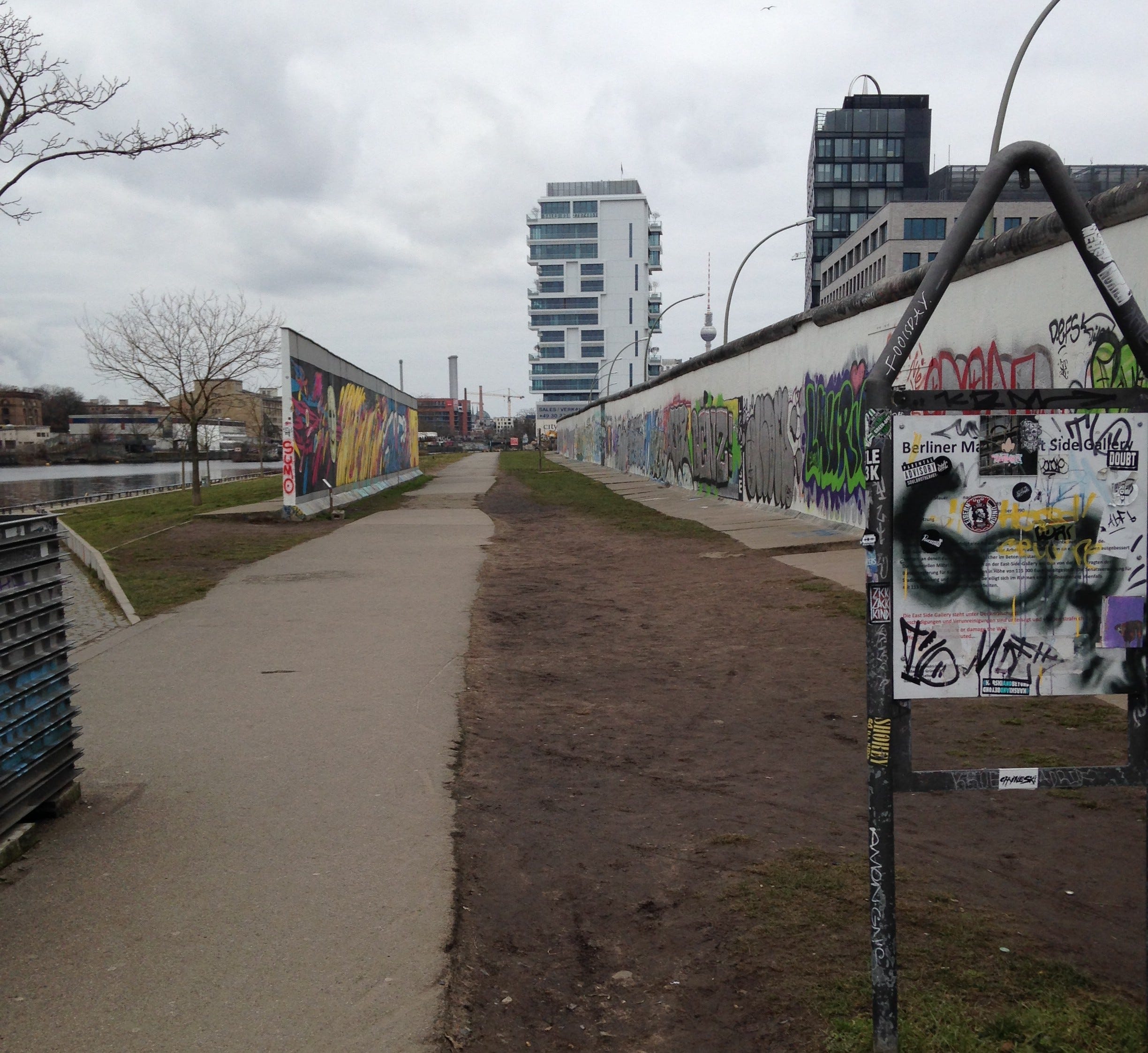
Parts of the Berlin Wall still existed in the winter of 2018.
Below is section of the wall painted by Siegrid Muller-Holtz called Gemischte Gefuuhle, or Mixed Feelings. According to the artist’s website page, “The painting is both a warning and an appeal to prevent man-made disaster and protect the world.”
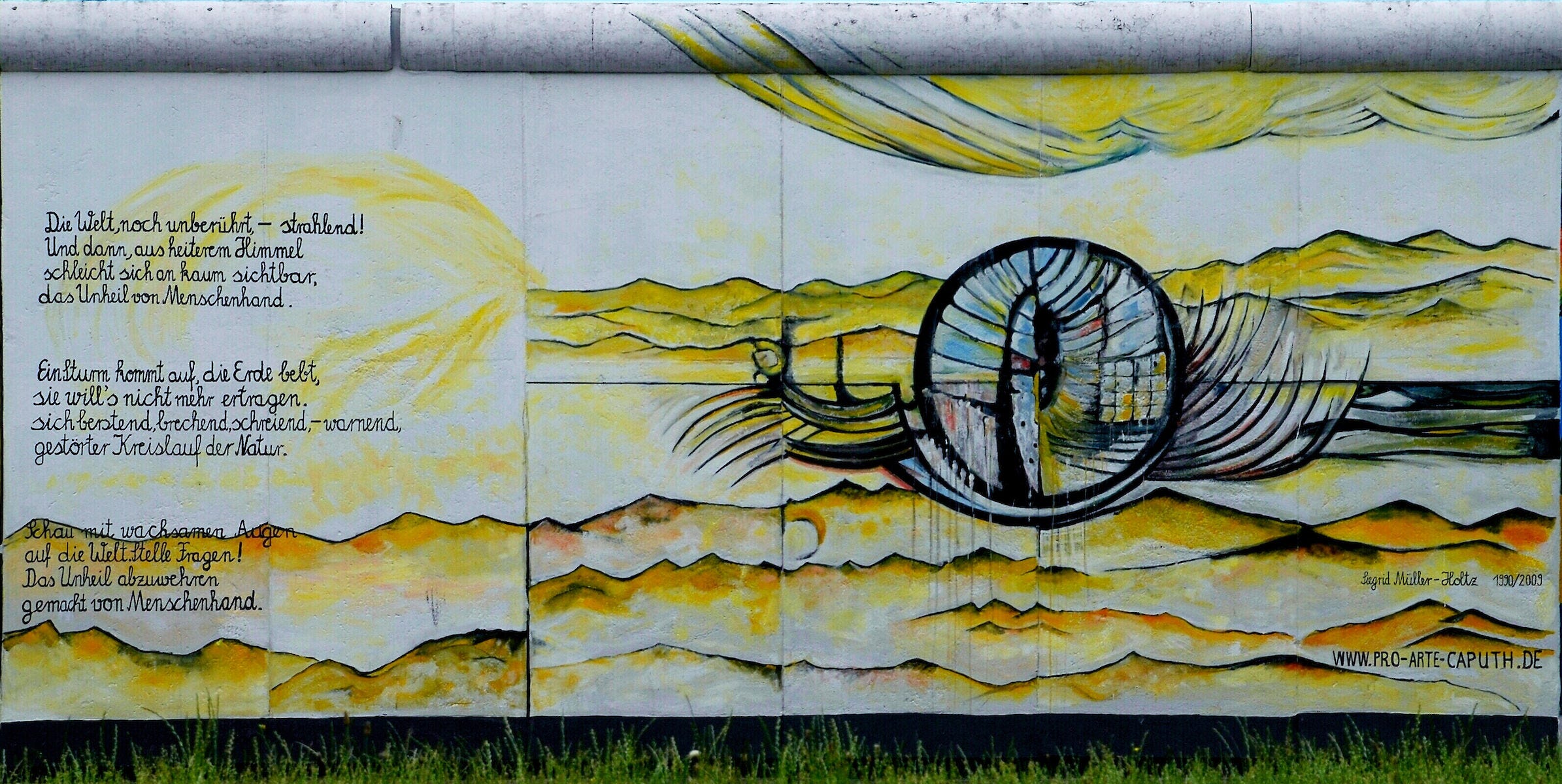
A section of the Berlin Wall showing ‘Gemischte Gefuhle’ by the artist Siegrid Muller-Holtz.
Also in Berlin, Anna and I went to a Jewish memorial. The memorial was empty. I did not take any photos, but I did take a photo of a Stolperstein, or one of the stumbling blocks embedded in a walkway. Stolperstein are “four-inch concrete cubes, with a brass plate inscribed with the name and life dates of victims of Nazi extermination or persecution.” They are in 31 counties in Europe and all over Germany. There are some in Jena.
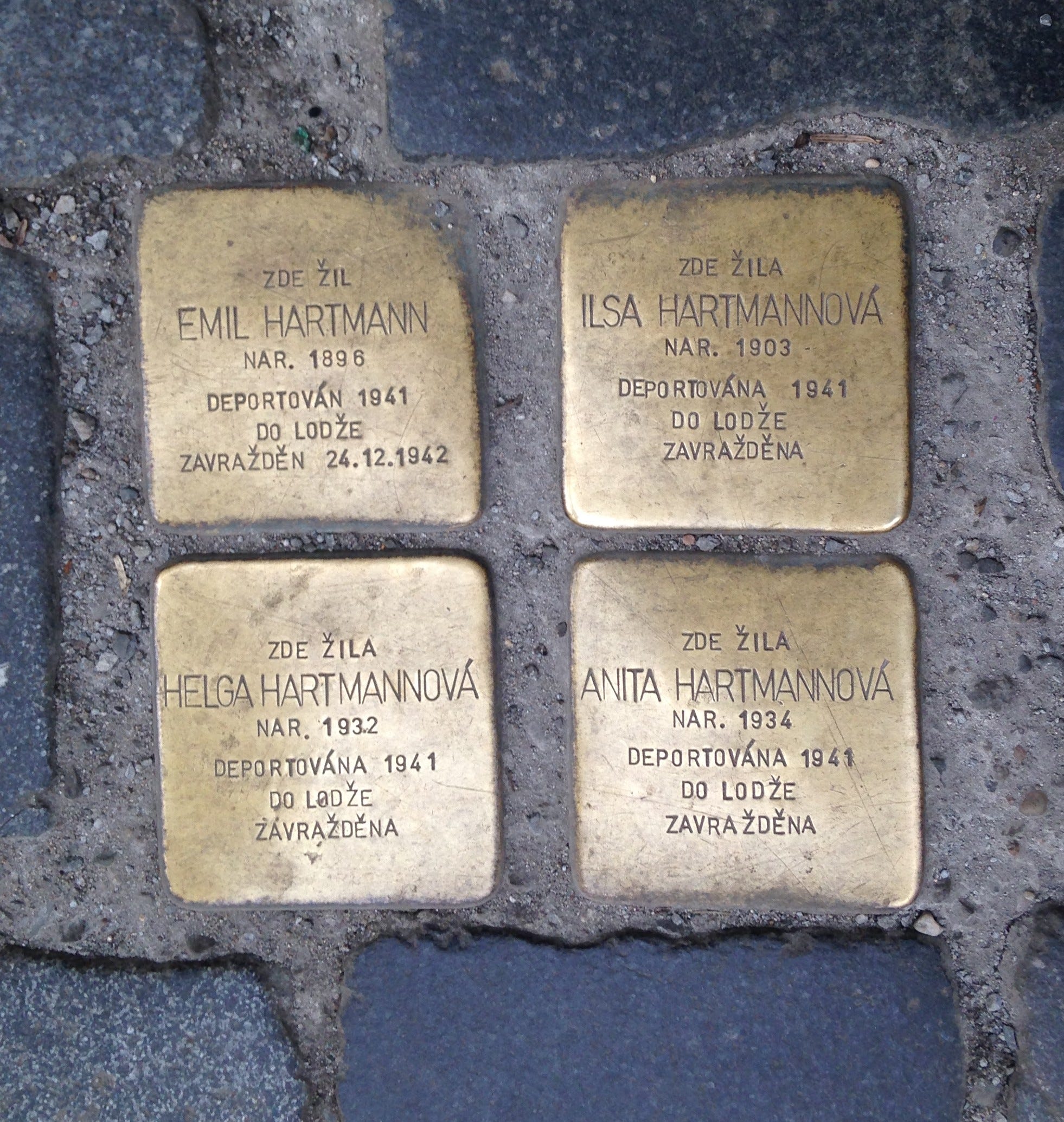
Stolperstein in a Berlin walkway. Helga Hartmannova was born in 1932, deported in 1941 to Lodze. She was nine years old.
I asked Anna’s in-laws – Eveyln and Wolf – who grew up in the GDR how they felt when the wall fell. “We only knew what we knew.” I think that means not much information about how others lived made it past the wall. There was no internet anywhere. Television was state-controlled. People who tried to escape from East to West Berlin were often killed by the border guards.
But censorship was not absolute. Wolf mentioned seeing Bruce Springsteen on July 19, 1988, in East Berlin, 16 months before the wall fell. Wolf did not understand English, but he said it was something he would never forget. Over 160,000 tickets were issued but somewhere in the neighborhood of 300,000 to half million young people showed up. This is what the BBC reported:
He spoke in German, which he had written out phonetically: “I am not for or against a government. I’ve come to play rock and roll for you, in the hope that one day all barriers will be torn down.” He was greeted with a roar of approval.
Germany 1936
This year when I visited Jena, I slept on the fourth floor of a house on a street called Ritzetal. From my bedroom window I had a view to Am Jenzig, which is a 1,264-foot tall mountain formed by sedimentary rock during the Middle Triassic, around 240 million years ago. All floors except where I slept were being renovated.
The house, which Anna and the gang would move into, was built in 1936. I wondered what Germany was like in 1936. This is what I found:
In 1936, Germany was a nation under the absolute control of the Nazi regime, with Adolf Hitler at the helm. The regime’s propaganda was pervasive, influencing every aspect of daily life, from education to entertainment. The economy showed signs of recovery. . . however the regime’s militarization and expansionist ambitions were already underway. The year was marked by significant events such as the Berlin Olympics, the remilitarization of the Rhineland, and the implementation of anti-Jewish legislation. The regime’s control over social life was evident in the indoctrination of youth through organizations like the Hitler Youth and the marginalization of those who did not conform to Nazi ideology. Despite the façade of national pride, the seeds of terror and repression were being sown that would lead to the outbreak of World War II.
Are We There Yet?
Decades ago, when you were on a long car ride with your parents, there were no cell phones. No video screens and no food. I can’t remember us ever eating in the car, and Mike (romantic interest and partner) has the same memory. You could count the cows on a hillside, play games with the license plates, or argue with a sibling. The question we asked our parents was: “Are We There Yet?”
So are we there yet?
The Kennedy Center was renamed the Trump Kennedy Center. (By Trump.)
Colleges and college professors are under surveillance. Some professors have been ordered to post syllabi. Students can complain about professors whose opinions they disagree with via tip lines.
The Trump administration is canceling $1.5 billion in grant money for California, Colorado, Illinois and Minnesota. All blue states.
Thousands of ICE agents had been sent to Los Angeles, Chicago, Portland and Minneapolis to ferret out the violent criminals. Estimates are that about two percent of those who were detained are convicted felons. (Like Trump: convicted felon. Thirty-four times by the state of New York.)
When is Enough Enough?
This next part is heavy. That’s the word my generation would use to describe something that takes some deep thought. Some would use the word ironically. I don’t mean it ironically. A lot of what follows is known, but not all of it, and certainly not by everyone. I felt this was important enough to say it again, and with my perspective.
On September 12th, Silverio Villegas Gonzalez was shot and killed in Chicago by ICE.
On October 4, Marimar Martinez, a U.S. citizen, was blowing her horn, alerting people to the presence of ICE when she was shot five times. She survived, and like others mentioned below, was accused by the government of being a ‘domestic terrorist.’
On New Years Eve, Keith Porter, while celebrating the New Year, was shot dead in a suburb in California by an ICE agent.
On January 6, Elizabeth Zuna and her mother “were driving to her school bus stop when federal agents intercepted the family’s car and blocked it with their own vehicles.” The 10-year-old spent a month in the Dilley detention facility in Texas. There were at least six other children from her school district in the same facility. Governor Walz in early February sent a letter to Kristi Noem: “No child should be incarcerated in America. Send our children home.”
On January 7, Renee Nicole Good, a U.S. citizen, and legal observer, was fatally shot four times: in her forearm, in her chest, and through her head.
On January 13, Aliya Rahman, a Bangladeshi American, who is autistic, was on her way to a doctor’s appointment when she was caught in a traffic jam. ICE gave her conflicting orders. As they smashed in her car window, she yelled, “I am disabled!” an ICE agent responded: “Too late.” She yelled, “I have a brain injury!” A knife came out of nowhere and cut her seat belt. ICE dragged her out of her car. She was taken to the Whipple Building (in Minneapolis) where she saw “lines of black and brown people chained together in the cold.”
Aliya Rahman was never asked for ID. Never read her rights. Never charged with a crime. Never given a phone call. Not given an opportunity to talk with a lawyer.
On January 20, the five-year-old boy in the blue bunny hat, Liam Conejo Ramos, was taken with his father (Minneapolis) and sent to Texas. They were released after 10 days only after a judge’s orders.
On January 24, also in Minneapolis, Alex Jeffery Pretti, an intensive care nurse, was directing traffic and filming ICE agents. When he tried to help a woman pushed to the ground by ICE agents, he was pepper-sprayed, forced to the ground and then he was shot ten times. He was shot ten times in five seconds. Also a U.S. citizen.
On January 26, Burce Springsteen came out with his song, “The Streets of Minneapolis.” It’s a great song, and you can google it and listen see footage of Minneapolis.
On February 3rd, Congressional Democrats convened a forum on Capitol Hill. The brothers of Renee Good, and some others, including Aliya Rahman, testified.
Not one single Republican showed up.
On February 10th, Democracy Now aired the voice of a nine-year-old from the Dilley Detention Center, Texas. She had been there over 50 days. “I don’t feel good… there are always officers around. I stay in my room.” And another immigrant, a 14 year-old girl, had lived in the U.S. for seven years, and has been in Dilley (to date) for 45 days. “I have never felt so much fear. . . I feel sadness and mostly depression.”
As of February 11th, it was estimated 3,800 children were in detention centers in the U.S..
Detention Facilities
There are around 70,000 people in ICE detention in the U.S. and twice as many – 224 – facilities as last year. And more ICE agents. According to Robert Reich, “ICE’s latest recruitment ads [are] built around the music and language drawn straight from the far-right, neo-Nazi memes and aimed at extremists.”
ICE seems to think 224 detention centers are not enough. Recently ICE bought a facility – a facility the size of seven football fields -- in Surprise, Arizona. According to Heather Cox Richardson,
On Tuesday, February 3rd, more than a thousand people turned out for the Surprise City Council meeting to oppose the establishment of the federal detention center. One of the speakers reminded the council of Ohrdruf, the first Nazi camp liberated by U.S. troops, on April 4, 1945. He said:
. . . A U.S. Army colonel told the German civilians who viewed the scenes without muttering a word that they were to blame. One of the Germans replied that what happened in the camp was ‘done by a few people,’ and ‘you cannot blame us all.’ And the American, who could have been any one of our grandfathers, said: ‘This was done by those that the German people chose to lead them, and all are responsible.’
The morning after the tour, the mayor of Ohrdruf killed himself. And maybe he did not know the full extent of the outrages that were committed in his community, but he knew enough. And we don’t know exactly how ICE will use this warehouse. But we know enough. I ask you to consider what the mayor of Ohrdruf might have thought before he died. Maybe he felt like a victim. He might have thought, ‘How is this my fault? I had no jurisdiction over this.’ Maybe he would have said, ‘This site was not subject to local zoning, what could I do?’ But I think, when he reflected on the suffering that occurred at this camp, just outside of town, that those words would have sounded hollow even to him. Because in his heart he knew, as we do, that we are all responsible for what happens in our community.
Mike’s father-in-law, Bill, was liberated by the Americans from a concentration camp when he was 16. He had been in four concentration camps including Auschwitz. My father-in-law, Peter, was 18 or 19, and suffering from typhoid, when the Americans liberated him from Mauthausen. Both men died in their 90s. I can’t imagine what they would think about America right now, today: where we are, and what we are doing to other human beings.
Notes
East Side Gallery Berlin: Siegrid Müller-Holtz – Gemischte Gefühle
What are Stolpersteine? Quick Guide to Europe's Stumbling Stones
How Bruce Springsteen rocked the Berlin Wall
what was Germany like in 1936 - Search
US citizens shot at, dragged by immigration agents, testify before congressional Democrats
How Universities and States Are Increasing Surveillance of Professors - The New York Times
Killing of Alex Pretti - Wikipedia
Heather Cox Richardson substack, February 7, 2026
Walz Presses DHS To Disclose The Number Of Kids Detained By ICE In Minnesota
Democracy Now, February 10th, 2026, on the children in Dilley Detention Center.
Children Describe Life Inside Dilley ICE Detention Center — ProPublica
Democracy Now, February 9, 2026.
Not a Single Republican Shows Up to Hear Renee Good’s Brothers Testify | The New Republic
Opinion | The Depravity of Trump’s Immigrant Detention - The New York Times
Thank you for another beautifully-written and important post.
Pat, omg.